
APFC Panel Services in Nizamabad
In facilities where motors, pumps, compressors and other inductive equipment operate regularly, maintaining a suitable power factor becomes an important part of electrical system management. As equipment operates, it can create reactive power demand, which affects how efficiently the electrical supply is utilised.
An Automatic Power Factor Correction (APFC) panel helps manage this requirement by switching capacitor bank stages according to changing load conditions. This allows the system to respond to power factor variations instead of depending on manual adjustments.
Risha Power Solution provides APFC Panel Services in Nizamabad for industrial units, commercial buildings and other facilities that need support with power factor correction equipment. Our work includes installation support, inspection, maintenance, troubleshooting and improvements based on the existing electrical arrangement.
Understanding How an APFC Panel Works
An APFC panel monitors the power factor of an electrical installation and automatically controls capacitor stages to compensate for reactive power demand.
Its controller receives information from the electrical system and decides when additional capacitor stages should be connected or disconnected. This process helps maintain the required power factor under changing operating conditions.
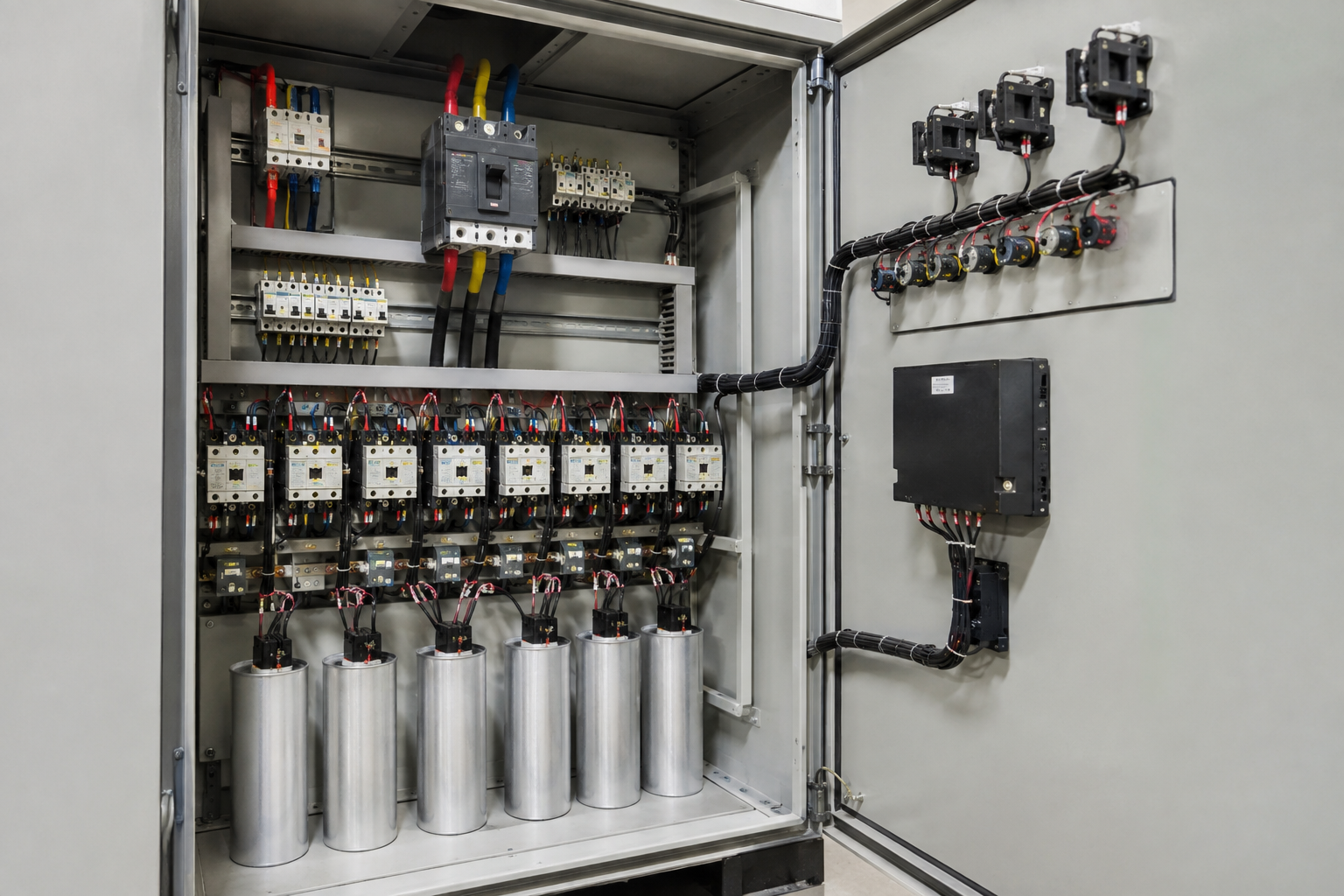
The main components generally include:
APFC Controller: Monitors the power factor and controls capacitor switching according to the configured settings.
Capacitor Banks: Supply the required reactive power compensation to the installation.
Switching Contactors: Connect or disconnect capacitor stages as instructed by the controller.
Current Transformer (CT): Provides current information required for monitoring and control.
Protection Devices: Help protect the capacitor circuits against specified electrical faults.
Panel Enclosure: Houses the components and provides physical protection.
The selection and arrangement of these components depend on the facility’s load requirements and electrical configuration.
Power Factor Problems in Industrial Operations
Power factor can change depending on the equipment connected to the supply. Facilities operating motors, welding equipment, pumps, compressors and other inductive loads may experience variations throughout the working day.
A poor power factor can increase the current required for a given level of useful power and contribute to additional losses in the electrical distribution system.
Some common situations that may require attention include:
- Power factor readings frequently falling below the desired level
- Capacitor stages switching irregularly
- Changes in load affecting compensation
- Capacitor banks failing to respond
- Unusual heating inside the correction panel
- Repeated operation of protective devices
- Inconsistent readings from the APFC controller
Our power factor correction services in Nizamabad help customers investigate these conditions and understand whether the existing compensation arrangement needs adjustment or repair.
APFC Panel Installation for Different Load Requirements
A correction panel should be selected according to the actual electrical demand of the facility. Installing an unsuitable capacitor bank may lead to poor compensation or other operating problems.
Our APFC panel installation in Nizamabad begins with understanding the connected loads, existing power factor readings and expected operating conditions.
The installation requirements may include:
- Reviewing the existing electrical distribution arrangement
- Understanding the reactive power requirement
- Selecting suitable capacitor bank capacity
- Determining the number of switching stages
- Reviewing controller compatibility
- Considering protection and ventilation requirements
- Planning suitable connections with the electrical system
A properly planned installation helps the correction arrangement respond more effectively to changes in electrical demand.
Capacitor Bank Selection and Arrangement
Capacitor banks are the main compensation elements inside an APFC panel. Their capacity and switching arrangement should match the reactive power requirement of the installation.
A facility with relatively stable loads may have different requirements from one where several machines start and stop throughout the day.
Our capacitor bank services in Nizamabad can support customers who need assistance with capacitor selection, installation-related requirements, inspection or maintenance.
During an assessment, attention may be given to capacitor condition, stage arrangement, switching devices, connections and visible signs of deterioration.
Managing Power Factor in Commercial and Industrial Facilities
Different businesses have different operating patterns, and their reactive power requirements can change throughout the day.
For manufacturing units, motors and production equipment may create varying demand depending on operating schedules. Commercial buildings may have changing requirements because of HVAC systems, lifts, pumps and other equipment.
Our industrial APFC panel service in Nizamabad support facilities that need suitable compensation arrangements for their electrical loads.
Similarly, commercial APFC panel services in Nizamabad can help buildings review their existing correction equipment and identify areas that may require maintenance or improvement.
Existing APFC Panel Servicing
An APFC panel can develop performance problems over time because of electrical loading, component ageing, repeated switching, environmental conditions, or changes in the facility’s load profile.
A panel that previously performed well may begin showing symptoms such as:
- Power factor not reaching the expected level
- Capacitor stages failing to switch
- Frequent controller alarms
- Uneven capacitor-step operation
- Abnormal heating
- Repeated fuse or protection operation
- Capacitor-related failures
- Inconsistent automatic correction
Our APFC Panel Services in Medchal can support inspection and servicing of existing systems based on the symptoms and condition of the installation.
APFC Panel Troubleshooting
APFC problems should not always be treated as a capacitor failure.
For example, poor correction may result from an issue with the controller, sensing arrangement, switching components, capacitor stages, protection, connections, or a change in the facility’s electrical load.
Troubleshooting therefore involves looking at the system as a complete arrangement.
Depending on the problem, the investigation may consider:
- Power factor readings
- Controller behaviour
- Capacitor-step operation
- Electrical connections
- Protection devices
- Capacitor condition
- Load characteristics
- Recent changes to the electrical system
This helps identify the area requiring attention before unnecessary components are replaced.
Maintenance of Capacitor Banks and Switching Components
1. Capacitor Condition Review
Capacitors should be examined for visible swelling, leakage, damage or other signs of deterioration. Abnormal conditions may indicate that a particular stage requires further investigation.
2. Checking Switching Contactors
Contactors operate whenever capacitor stages are connected or disconnected. Their physical condition and switching behaviour should be reviewed to identify wear or possible contact problems.
3. Reviewing Controller Operation
The controller display and switching response can be checked to understand whether the unit is detecting and responding to changing power factor conditions correctly.
4. Inspecting Internal Connections
Connections between capacitor stages, switching devices and associated components should be examined for looseness, discolouration or signs of overheating.
5. Examining Protection Arrangements
Relevant fuses, breakers and other protective components should be reviewed to identify visible deterioration or unsuitable operating conditions.
6. Checking Panel Ventilation
Capacitor banks and switching equipment generate heat during operation. Ventilation arrangements should be checked to ensure that heat can be managed appropriately.
7. Reviewing Stage Performance
The operation of individual capacitor stages can be examined to identify stages that are not switching as expected or are contributing to inconsistent correction.
How We Approach APFC Panel Projects
Every facility has a different electrical demand, so the work should be planned around the actual installation.
Initial Requirement Review
We discuss the customer’s existing setup, reported power factor concerns and the reason for requesting assistance.
Electrical System Assessment
The connected loads, existing correction equipment and available operating information are reviewed.
Component and Capacity Planning
Suitable capacitor stages, switching arrangements and controller requirements are considered according to the application.
Installation or Corrective Work
The agreed installation, repair or maintenance activities are carried out under appropriate electrical safety procedures.
Operational Verification
Relevant switching behaviour and available power factor readings are reviewed to check the response of the correction arrangement.
Why Choose Risha Power Solution?
Risha Power Solution & Constructions provides electrical and power-related services for commercial and industrial requirements. Our wider experience includes power quality assessment, electrical testing, thermography, earthing and electrical installation-related work.
This broader understanding is useful when APFC panel concerns are connected with load variations, distribution problems or other power quality conditions.
We focus on identifying the requirements of each installation and discussing suitable work based on the actual equipment and operating conditions.
Benefits of a Properly Maintained APFC Panel
A suitable correction arrangement can provide several advantages for a facility:
- Helps maintain the desired power factor under varying loads
- Reduces unnecessary reactive power demand from the supply
- Can help reduce current-related distribution losses
- Supports better utilisation of electrical system capacity
- Helps identify deteriorating capacitor stages
- Provides automatic compensation according to load conditions
- Supports more organised electrical maintenance
- Helps businesses monitor their power factor performance
Actual benefits depend on the installation, load characteristics, system design and the condition of the correction equipment.
When Should You Consider APFC Panel Upgradation?
1. Increased Electrical Demand
When additional machines are introduced, the reactive power requirement may change. The existing capacitor bank capacity should be reviewed before making further additions.
2. Frequent Controller Switching
If the controller repeatedly switches capacitor stages without maintaining stable correction, the configuration and stage arrangement may need examination.
3. Ageing Capacitor Banks
Older capacitors may gradually lose their effectiveness. Their condition should be assessed to determine whether individual units or the complete bank need replacement.
4. Changes in Production Equipment
Replacing older machines with different equipment can change the facility's power factor characteristics. The compensation arrangement may need to be reviewed accordingly.
5. Insufficient Compensation Capacity
If the existing arrangement cannot meet the facility's reactive power requirements, additional or suitably sized stages may be considered after technical assessment.
6. Repeated Component Failures
Frequent issues involving contactors, capacitors or protection devices may indicate that the existing configuration requires improvement.
7. Addition of Non-Linear Loads
Equipment such as variable frequency drives and other electronic loads may introduce harmonics. The system should be assessed before adding conventional capacitor banks, as harmonic conditions can affect capacitor operation.
Frequently Asked Questions (FAQ)
1. Does an APFC panel work when the factory load keeps changing?
Yes. An automatic correction panel is designed to respond to changing reactive power requirements by switching capacitor stages. Its performance depends on correct configuration, suitable stage selection and proper operation of the connected components.
2. What happens if the capacitor bank is oversized?
An oversized capacitor bank can cause excessive compensation and may result in a leading power factor under certain load conditions. Proper capacity selection is important to avoid overcompensation.
3. Can an APFC panel be used with variable frequency drives?
It can be used in installations containing variable frequency drives, but harmonic conditions should be evaluated. Depending on the results, suitable detuned or filtered compensation arrangements may be required.
4. Why does the APFC controller show a different power factor reading?
Incorrect CT polarity, wiring issues, configuration settings, measurement conditions or changes in the load can affect the displayed reading. The measurement arrangement should be checked before changing controller settings.
5. Do all capacitor stages need to be replaced if one capacitor fails?
Not necessarily. The condition of the remaining units and the overall bank should be examined. Replacement requirements depend on the test results, capacitor specifications and operating condition.
6. Can an APFC panel help reduce electricity expenses?
A suitable correction arrangement may help reduce power factor-related penalties where the electricity tariff applies them. The actual financial benefit depends on the utility tariff, existing power factor and facility consumption.
Get APFC Panel Support in Nizamabad
Managing reactive power is an important part of maintaining an organised electrical distribution system, especially in facilities where motors and other inductive equipment operate regularly. An APFC panel that is correctly selected, configured and maintained can help respond to changing electrical demand.
Risha Power Solution provides APFC Panel Services in Nizamabad for customers who require new installations, capacitor bank support, controller inspection, troubleshooting, maintenance or system improvements.
Whether you are planning a new correction arrangement or experiencing problems with an existing unit, our team can discuss your requirements and help identify a suitable approach.
About Us
Risha Power Solution and Constructions takes this opportunity to introduce ourselves as a Safety, Health, Hygiene, Risk, and Environmental Management company based in Hyderabad, India.